Showing posts with label energy efficiency. Show all posts

Friday, 5 April 2013

LED lighting can prolong stock's shelf-life for retailers - report

Installing LED lighting in supermarkets is becoming increasingly popular
The ability of LED lighting to benefit food retailers has been highlighted by the Environmental Data Interactive Exchange (EDIE).

EDIE reports that supermarkets are responsible for up to 300,000 tonnes of food waste every year, and with LED lighting this could be dramatically reduced.

With LED lighting emitting less heat and no UV rays, food under its scope will not 'sweat in its packaging' according to EDIE and could therefore last much longer.

This will come as no surprise to retailers who have benefited from LED lighting in their stores already, with additional benefits such as reduced carbon emissions, and large savings made on running costs and maintenance.

The EDIE story goes on: "A report released in January by the Institution of Mechanical Engineers revealed that two billion tonnes of the world's food production is going to waste each year.  

"It also stated that up to half of all food bought in Europe and the US is thrown away by the consumer, and smarter strategies around water conservation and waste prevention could potentially provide 60% to 100% more food."

To read the full story on EDIE click here.

Thursday, 20 December 2012

Why more and more restaurants are eating up LED lighting

Of all the regular clients using LED lighting solutions, restaurant and cafe owners are probably not top of any prolificacy lists.

They do, however, have extensive overhead costs to consider like everyone else when balancing the books of their business, and their energy bills are primary among those concerns.


Busy restaurant
Restaurant owners have enough to deal with
without thinking about  rising energy costs
As well as powering kitchen equipment such as cookers and storage facilities, lighting and computing requirements make restaurants one of the biggest user groups of electricity across the world. In the United States for example the annual energy bill for the commercial food service sector is estimated at $10bn, according to environmental protection agency Energy Star.

To drive down their running costs, and also reduce their carbon impact on the environment, several chains and sites are making the change to LED lighting – but are they doing it the right way?

The transfer to more energy efficient LEDs is an easy decision to make. With better power to output ratios, LEDs are far more energy efficient solutions in comparison with fluorescent or sodium light fittings that are more commonly found in restaurants. As well as reducing energy costs, the longevity and durability of LEDs also means a cut in the cost of repairing and replacing lighting, and installations of LED lighting, both interior and exterior, have seen many reduce their carbon emissions year upon year.

So what can go wrong? Well LEDs are becoming increasingly adaptable, their ability to replace traditional lighting setups means they can be found in more and more locations in and around homes and businesses today. Their use has stretched to LED lamps also, which boast all the benefits of regular LED lighting fittings with the convenience of coming in a small package. However these come at a significantly higher cost than market alternatives, and do not have the lifespan of their larger cousins.

High quality LED lighting specialists manufacture their own LED product ranges in order to maximise the benefits that LED lighting can bring to the user, installing and testing their products in optimum conditions for maximum capacity.

Restaurant
Lighting is a key consideration for
restaurants looking to create the right mood
LED ceiling tiles, street lights and bollard lights are all available as complete packages, and installation of these fittings can mean bigger savings over longer periods for users. Take an average restaurant with car parking for example; the owners could replace the lamps in their street lights, interior lights in the dining area, and lights in the kitchen and offices with LEDs. But to maximise their savings, they could replace all of these with brand new, vandalism and weather-proof, environmentally friendly LED light installations.

It isn’t just about cost reduction with LEDs either. Every successful restaurant has a theme and a mood it creates for its customers, who will return time and again to experience that unique feel. Several factors go into making this possible, and lighting can underpin all of these attributes. An elaborate design layout with bespoke colour schemes can be rendered useless if adequate lighting fails to sufficiently bring out the tones of those colours. The colour rendering of LED lighting is excellent, and the strength of its bright white light is more aesthetically pleasing than the pale yellow hue that can be emitted by older lighting systems, particularly as their lifespan diminishes.

This technical superiority also stretches to external uses, as LED lighting improves the picture clarity on CCTV pictures, meaning that your restaurant is more secure and ensuring that should anyone cause your business any damage you won’t face the frustration of seeing them walk away from punishment due to insufficient proof – a common problem for CCTV systems let down by sub-standard lighting (see our previous blog here for more on this).

Just as important as protecting your business itself can be protecting the name and brand of your restaurant. A flickering lamp over the bar area or seating in a dark corner of the room lessens the appeal to diners, and reflects badly on the professionalism of your establishment. Reliable and low maintenance LED lighting do not suffer from these problems, and with increasing developments in control technologies and dimmer switches, the levels of customisation available for LED lighting are becoming increasingly more effective.

Some of the biggest names in the restaurant industry have switched to LED in recent times, the likes of McDonalds, Nandos and Cafe Nero to name but a few. When LED lighting becomes the norm for all restaurants, do you want your restaurant to be the one left behind, and more importantly – can you afford it to be?

Leave us your comments in the box below.

Friday, 7 December 2012

Challenges and issues discussed at NPL's LED Street Lighting Conference


Gemma Lighting were delighted to attend the Best Practice in LED Street Lighting Conference at the National Physical Laboratory earlier this week, engaging in seminars and discussions on one of Gemma’s key product areas.

LED Street Lighting is quickly becoming the best option for many businesses and authorities across the country, and on this day of debates including participation from contractors, designers and manufacturers subjects such as measurement, application and financing were raised between the members present.

National Physical Laboratory logo The NPL hosted the event at its base in Teddington, Middlesex and being home to the Centre for Carbon Measurement the world-leading centre of excellence in developing testing systems was the ideal location to host the day’s proceedings.

Gemma were one of the many LED specialists in attendance with Mike Elwell discussing the challenges of implementing solid-state lighting (SSL) in the first session of the day.

Mr Elwell spoke of the influence of industry bodies such as the Institution of Lighting Professionals (ILP), which was formed in 1924 and now has more than 1900 members.

As with many considerations regarding local authorities in the current climate, the issue of reducing number of consultants in local councils in order to reduce consultancy fees was highlighted as an issue with regards to implementing new SSL, and Mr Elwell highlighted some common reasons given for not switching to improved lighting solutions such as LED.

These were discussed throughout the day but what all delegates were in agreement of was that these common issues were misunderstood – the cost of installing LED light fittings for example was considered too expensive even though prices are lower than when the technology first became available and funding schemes are there to aid local authorities in reducing costs and cutting carbon emissions via projects such as LED lighting.

Of course being at the NPL there was a heavy focus on testing and measurement also, and Mr Elwell highlighted the need for more stringent testing that would become standard across the industry – something Gemma and the other manufacturers present certainly welcomed, as this means higher quality products manufactured in the UK, such as those made at Gemma’s base in Portsmouth, will stand out from cheaper foreign imports.

We then heard about the relationship between the NPL and their Dutch counterparts VSL who have worked together on metrology and environmental factors affecting SSL performance, and from Huw Convery on a street lighting project in Salford before a LUX-TSI presentation on measurement and data confirmation.

After lunch Teresa Goodman from the NPL looked at the relevance of mesopic photometry in LED street lighting, and went over the means in which it can be calculated, followed by a presentation by Steve Fotios of Sheffield University on his MERLIN project, which stands for mesopically enhanced road lighting: improving night-vision.

A panel discussion with the various speakers from the day saw questions raised about LED performance, warranties and power supply options that saw engaged input from many of the gathered delegates.

Andrew Dennington was next to speak on free-form optics and the design and validation process behind their performance, and Graham Scragg took the final session of the day by presenting street lighting projects in Birmingham and Sheffield.

LED Flood Lighting Spitfire 96
www.gemmalighting.com
One theme that clearly emerged from the day was the need for LED lighting specification standards to be mandatory in some form – providing customers with the peace of mind that the technology they are purchasing does what it claims to do in the factsheets. There are current guidelines such as the ‘Guide to specification of LED lighting products 2012’ from the Lighting Industry Liaison Group (LILG) but nothing currently in UK law specifically regarding the design of LEDs.

Gemma Lighting tries to reassure its customers in other ways such as the three year warranty that comes as standard with all LED lighting, and the benefit of having the whole operation here in the UK, from the sales team to the factory floor, so customer communications to be handled easily and efficiently.

The high quality standards of Gemma’s products is one of the key benefits for users, as the longevity and reliability can lead to a lifespan of up to 100,000 hours and massively reduce maintenance costs, and with high IP protection rated fittings Gemma’s LED lighting range is durable against adverse weather conditions and vandalism.

Were you at the Best Practice Conference? Why not give us your thoughts on some of the issues using the comments box below.

Friday, 23 November 2012

Keep up-to-date with Gemma Lighting and learn more about LEDs through Social Media!

LED is no longer the strange new technology it once was - its cost-cutting, environmentally friendly benefits are now well-known to many business users and home owners around the world.

UK LED Lighting manufacturer

But with LED products so widely available now it can be hard to know where to turn in today's market. The key points you should look out for include reliability, longevity and quality service - all factors provided by Gemma Lighting Limited.

Designing and manufacturing from their UK base in Portsmouth, Gemma are LED lighting specialists who are growing their business year on year. Their all-inclusive service means all your LED needs can be served in one stop, with a dedicated team that can explore the best options possible for users looking to switch to LED lighting, the products from Gemma's wide range that would suit the customer's needs best, and ensuring the right payment options are available too.

To find out more about Gemma Lighting visit the website at www.gemmalighting.com, where you will learn about what Gemma stands for, and why LED lighting is the way forward for the future of the lighting industry. You can also browse the Gemma range of LED Lighting products, and learn more about LED leasing options. If you remain unconvinced, have a look at the case studies section to hear from other happy customers and keep up-to-date with the company goings-on with the news section.

You can even test your skill and nerve in the LED lighting game - fit as many LED street lights as you can within the time limit, and watch out for the seagulls who are after your health!

Get involved even further by joining Gemma Lighting on social media networks. The LinkedIn page is constantly updated with industry news, products and company news and you can also interact with Gemma and recommend LED products if you are one of the many clients who have been delighted with the results of installing Gemma's LED lighting.

Like our Facebook page and engage on a whole new level, sharing and commenting on stories and updates from Gemma. Post your photos of LED lighting and join the discussions with other users.

Follow the Twitter account of Gemma Lighting and join the debate. Keep posted on exciting new opportunities and industry news, as well as engaging with other customers and hearing about their experiences with LED lighting.

And of course don't forget to keep checking back to the Blog for news from around the world and the lighting industry as a whole, and learn how LED lighting can solve many of the biggest issues being faced in the current economic climate.

Are you one of Gemma Lighting's new fans, followers or readers?! Leave your thoughts and feedback in the comments box below.

Monday, 19 November 2012

How LEDs can make blackouts a thing of the past


Hurricane Sandy recently plunged New York, one of the biggest cities in the world, into total darkness as power outings hit the Big Apple in one of the biggest storms to hit the east coast in years.

Hurricane Sandy New York City blackout
New York residents make their
way through the blackout
The super storm flooded tunnels, streets and subway lines, cutting the power supply in the city and its surrounding areas as President Obama declared a state of emergency in New York as even now it continues to recover.

In the UK meanwhile, safe from the effects of such tropical weather patterns, local authorities up and down the country are facing a nightmare of a very different nature – the choice between making vital cost-cutting measures and ensuring the safety of local residents.

That’s how many see the decision to switch off thousands of street lights in order to save money on energy bills.

Many local residents have experienced a blackout usually in the early hours of the morning, as the cost of keeping the street lighting network running all night is proving too much for local councils already under pressure to trim costs due to diminished government funding.

A Daily Telegraph investigation that took place on the day the clocks went back an hour found more than 3,000 miles of motorways and trunk roads were completely unlit, and a further 47 miles of motorway have their lights switched off between midnight and 5am.

Earlier this year Nottinghamshire County Council announced it would turn off 90,000 street lights in order to save an estimated £1.25m, following Derbyshire County Council’s similar decision to save more than £400,000 a year by switching off street lights in rural areas between midnight and 5.30am. An investigation by the Daily Mail in fact found out that 21 out of 27 county councils in England were turning street lights off at certain times, or in some cases entirely, back in February.

LED Street Lighting Jupiter 72(2)
Jupiter LED Street Light www.gemmalighting.com
More than the convenience of having light through to the early hours, there is an argument that local road users will not feel safe when councils plunge them into darkness in order to save money.

Pedestrians are at particular risk - according to governmental crime statistics the number of personal robberies occurring in England and Wales has fallen progressively in the last four years but in 2009/10, the most recent year available, there were still nearly 80,000 cases recorded by the Police. The same can be said of sexual offences, with over 50,000 incidents reported to Police between July 2011 and June 2012. With pedestrians highly likely to be targets for both these crimes, effective and reliant street lighting is clearly vital to ensure their safety.

But how can councils balance the need for this safety with their tighter budgetary requirements and rising energy prices? By changing the type of lighting these authorities use, their street lighting could in fact remain on throughout the night whilst seeing their energy bills reduced thanks to more efficient LED street lighting.

LEDs convert more power to light, as opposed to traditional lighting sources that lose power through excess heat, and with no filament to burn out they are more reliable and can save users money on maintenance bills.
With a life span of up to 100,000 hours LED street lights offer long-term solutions for financially conscious councils. Schemes, such as the Green Lease for LED lighting, are even available whereby purchasers can offset the capital expenditure of LED replacement lights by making repayments through the savings they make in energy costs.

As part of the Telegraph investigation the Royal Society for the Prevention of Accidents said: "The presence of lighting not only reduces the risk of traffic accidents but also their severity. Surveys have shown that the public are in favour of street lighting as a way of improving road safety and that, if anything, it needs to be improved in some areas. There are economic and environmental reasons why some organisations may wish to reduce the amount of lighting. However there are safety reasons why lighting needs to be available."

With new LED technology, road safety and cost-efficiency need no longer be separate considerations for hundreds of authorities up and down the country, and the blackouts that are concerning so many, can be a thing of the past.

Have the street lights in your area been switched off? Give us your thoughts in the comments box below.

Tuesday, 13 November 2012

LuxLive 2012: Mark's diary


It’s a busy time here at Gemma Lighting as the days grow darker and November, known as the ‘buying month’ in the lighting industry, hits us like a brisk winter chill.

LED lighting exhibition LuxLive logo
As if that weren’t enough, November is also when we see LuxLive hit our calendars, the biggest exhibition event in the lighting industry.

Not wanting to miss out on the debates and latest industry news, Gemma Lighting were represented at Earls Court by our marketing administrator Mark Allaway, who shares his thoughts with us in this special LuxLive blog:


“Being a newcomer into the LED lighting industry isn’t easy.

For the past few weeks I’ve been learning my lumens from my CRIs, my LEDs from my metal halides and my high bays from my low bays.

Travelling up to Earls Court London for the biggest exhibition in the lighting industry, LuxLive, last week, I was bright-eyed and bushy-tailed ready to get a more in-depth understanding of what the issues in the industry really were.
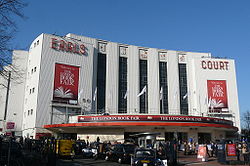
Earls Court exhibition centre London
London's Earls Court hosted the event
I had already discussed with my colleagues at Gemma Lighting some of the issues – the issue of low quality products infiltrating the market at low prices and giving LEDs a bad name. The issue of ‘hero numbers’, where sales personnel talk up what their products can do whilst ignoring and concealing their obvious downsides. And the issue of stoicism in the way some industries think about their lighting setup, being confused by new LED technology and not wanting to change from their fluorescent or sodium-set ways.

Thoughts in my head during the train ride to London surrounded what other lighting manufacturers were doing to combat these problems, were these issues steadily being resolved, and what did the future hold for LED lighting?

The last question was answered to some degree upon my entrance to Brompton Hall, where I saw the number of stands, exhibitors and visitors at LuxLive 2012. I was thoroughly impressed with the hustle and bustle of the venue considering it had only been open a matter of minutes when I arrived. Some had already begun their caffeine intake for the day.

LED lighting exhibition LuxLive Formula One car
The Caterham F1 car at LuxLive 2012
After a quick look at the winners of the Lux Awards from day one, I made my first lap of the circuit, taking in the different shapes, sizes and colours of the exhibiting stands on display, passing (as you do) a Dalek and a formula one car on the way - LED lighting car.

Then I hastily made my way to the Design Clinic Live, where Lux Review publisher Gordon Routledge was speaking on how LEDs are reshaping the lighting business. Gordon spoke of how LEDs are progressing into areas where they have not traditionally been considered as relevant options – the ability of some LED products to take on the dreaded T5 ceiling light in offices being cited as one example.

Gordon also talked about how customers that are engaging with the lighting industry now are very different customers than before. Previously you may have spoken to the CEO or MD or perhaps the branch manager when discussing new lighting solutions, but now you may be speaking to the facilities manager or the environmental officer, meaning the benefits of switching to carbon-reducing energy efficient LED lighting is already known to the customer, and therefore reducing the barrier that educating the customer on how the technology works used to prove.
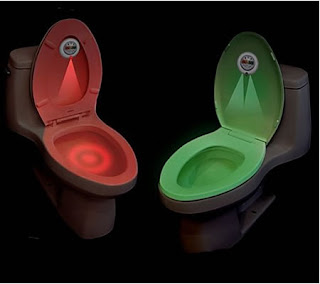
LED lighting toilet seat
LEDs are being used for all sorts...
With the average age of lighting in the UK reported to be 18 years, Gordon said, more efficient lighting technologies are opening up more possible uses for lighting itself. The examples that followed included the wonderful to the wacky – from a clever use of lighting on handrails in a pedestrian subway to a toilet with a bowl that was backlit with bright white LED light.

Wishing to remove that image from my mind, and having a little time before the next session scheduled in my plan for the day, I decided to tour the stands a little more, seeing what some of the biggest organisations around had in the pipeline. I noted that even though LuxLive was a demonstration of what the whole lighting industry could do, LEDs were so dominant, both in the number of products on display and the number of times they appeared in the debates and seminars. LED Street Lighting was on show on many stands, with chips, drivers and bulbs all being showcased as well.

It was with some intrigue that I attended the next session in the Design Clinic Live, titled ‘LEDs: What they don’t tell you in the spec sheets’. Rather than highlighting the downfalls of LEDs as the title suggested, this session was actually about how consumers can better understand what spec sheets are telling them, and how to understand the figures. The Ska rating system from the Royal Institution of Chartered Surveyors (RICS) was highlighted as a way of comparing LED lighting, as well as the criteria found on the Energy Technology List (ETL). Fittings that comply with the latter may be entitled to tax refunds, further advancing the appeal of LED to customers.

LED Car Park Lighting Jupiter Marriott Hotel
Gemma Lighting has worked with several
Marriott hotels on  LED Car Park Lighting
Hotels and their use of LEDs was next under the spotlight, and I was interested in the considerations that hotels go through when choosing their lighting setups. It may not be rocket science but subtle changes in the way lights are installed, angled and coloured can have a major aesthetic impact on a hotel environment, and all three factors can really affect the mood of the room, a key consideration in areas such as bars, rooms and restaurants for example. Examples were shown whereby poor lighting products or lack of maintenance had led to instances where the brand of the hotel itself was at risk of being damaged. The aforementioned issue regarding industries that were reluctant to make the change to LEDs rang true here also – but it would appear this is changing.

After a break for lunch I made a particular note to grab a seat early for a session in the Tech Theatre, for a talk entitled ‘LEDs: Under the bonnet’. As a newcomer this, I had hoped, would prove to be a good test to what I had learned so far and may provide some extra technical nuggets of knowledge for me. I was not disappointed. I learnt about the dangers of ‘colour shift’ in poor quality products, regulatory tests such as LM-80 and TM-21 and more about the key components of LEDs.
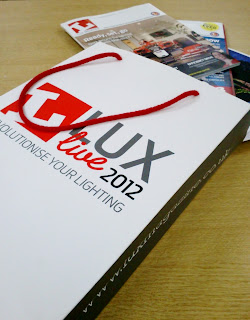
LED lighting exhibition LuxLive
Mark brought this back from his busy day!
My final talk of the day was again in the Tech Theatre, with a discussion on light colour and quality of LEDs. There was more talk of lab tests and the lumens-per-watt figures that are being achieved behind closed doors, the different mixes that can create bright white LED light aside from the traditional mix of naturally blue LEDs and yellow phosphor, and an important point on colour rendering index, and how having a top score of Ra100 may not mean that a particular LED light is the best choice for a certain project.

Before the day was out I met with several of the lighting publications who were also in attendance and was able to speak with some lighting enthusiasts who had come all the way from Germany to be at LuxLive on the tube journey back to Waterloo.

All in all my busy day at LuxLive was a great eye-opener and great timing for this LED rookie to gain an insight into the industry.

The scale of LuxLive and wealth of knowledge and debate on show this year makes me certain that LuxLive 2013 will be an event to remember for LED Lighting Manufacturers and users alike.”

- Mark A.

What do you make of Mark's account of the day? Were you at LuxLive too? Leave us your comments below.